Friday, 18 November 2022

Thank you for the radishes: Edmund Wilson in dialogue with Helen Muchnic


In 1942, the literary critic and Princeton graduate, Edmund Wilson, then forty-seven, made friends with a scholar of Russian literature slightly younger than himself, Helen Muchnic. Born in Baku in 1902, Helen  emigrated to the US as a child; after an intensely illustrious academic career, she was teaching at the elite Massachusetts women's college, Smith. Wilson did not usually like academics, but he took a shine to Muchnic. They started exchanging letters - about Gogol, Pushkin, Turgenev, everything and anything to do with Russian literature - as they would continue to do for the next thirty years, until Wilson's death in 1972 ('Do let us talk about Gogol when I see you. He is certainly a very strange man', Wilson wrote to Muchnic in 1943). 

It was the beginning of a beautiful friendship that would outlast many books by each of them, many of Wilson's affairs and at least one of his marriages. They soon progressed from Dear Miss Muchnic to Dear Helen, a level of familiarity that would endure (Wilson never signed off with his nickname 'Bunny', dropping his surname only in the final decade of their correspondence). At the time they met, Wilson was still married to his third wife, the novelist and critic Mary McCarthy. By December 1942, Muchnic was a welcome guest at the Wilson-McCarthy household: on December 22 that year,Wilson sent her a telegram with instructions for reaching their home at Wellfleet, near the tip of Cape Cod, where he famously hid out from the hothouse of New York society. After catching various trains, Helen was to change onto a bus in Yarmouth: 'Mary will be on bus'. The mere idea of hailing a bus on which Mary McCarthy is already seated, to progress to an intimate dinner with the cream of East Coast intelligentsia, baffles my saurian brain. Yet, clearly, Helen Muchnic held her own, and brought vegetables, too. In summer 1943, Wilson followed up another dinner with this note:   

 'I have delayed answering your letter and thanking you for the radishes because I had to go away for a week and got no chance to write any letters. First of all, we were delighted with the radishes. I am especially fond of radishes, and these are the best I have had for years. When I was a child, I used to cut them in little slices and eat them on bread and butter, and I ate a great many of these that way (made the better part of a lunch and a supper on them). Many of the radishes you buy or get in restaurants have been allowed to get too big and coarse, and the taste is too sharp. You seem to have pulled these at just the right time'. 

The rest of the letter is about Thomas Hardy, Allen Tate, and Antigone. Later that same year Wilson added: 'We have been having a wonderful time with your vegetables. We have had some wonderful novelties such as Vichysoisse soup made out of sorrel or squash, and slices of squash fried or something in a way that is delicious. They really have been a great treat'. This letter has two added scribbles: a ragged one from Wilson about Dostoevsky's sense of humour, and a neat cursive addendum by Mary McCarthy: 'Edmund has already mentioned the vegetables to you - the lettuce was heavenly and this time came through well, Is the small spear-like one romaine or a new variety of lettuce?'  While there have been various accounts of the Wilson-McCarthy marriage and its discontents (including two by their son Reuel), their relationship has surely never been viewed before from the perspective of mutual salad appreciation. 

Several months after the radish and romaine revel, on October 23rd, Wilson invited Muchnic to see a version of Gogol's The Fair at Sorochinsk 'at the Russian ballet'; he asked her to queue for the tickets, but enclosed a cheque to cover the costs. As an apparent afterthought, he scrawled under his signature: 'They have offered me Clifton Fadiman's job reviewing books on the New Yorker, & I've decided to take it for a year, though I doubt whether anything good but money will come of it'. On August 7th, 1944, Wilson wrote to Helen: 'The Nabokovs are here in Wellfleet [...]. Vladimir & I have been giving each other quizzes on our respective languages. Here is one of his more interesting questions. How would you answer it? Put into Russian the following sentence: At the harbor I saw many masts and had many day-dreams (using мечта for day-dream)'. Thus, with a scribble and a pun or two, historic literary relationships were forged.

By February 1945, when Wilson was finishing a book (presumably Europe Without Baedeker) while managing New Yorker reviews, his tone regarding Mary had changed: '[...] don't take too seriously anything Mary may have said, when you saw her. Her way of seeing herself in a drama doesn't always make connections with reality. Lately she has been acting out a novel when she ought to be writing one'. By October that year, he confided that his teenage daughter 'Rosalind has just moved in with me and we have been having quite a good time together fixing the place up'; Muchnic was already settled in a senior position at Smith, where she had started as an instructor in Russian in 1930, aged 28. The following year, 1946, Wilson was trying to get a divorce so as to marry yet again, to Elena Mumm Thornton, of the Mumm champagne dynasty. Elena was a member of the Struve family and a native Russian speaker; her grandfather had been the Russian ambassador to Japan. In his letters to Muchnic, Wilson fretted that Mary might 'obstruct it' (the wedding) with more fuss 'in court over nothing'. Clearly, Mary was no longer on the bus. In May 1948 Wilson shared the news of his and Elena's new baby, and asked if Muchnic had heard that Vladimir Nabokov would soon start teaching Russian at Cornell ('They are immensely pleased about it , as it means a good salary, & it happens to be one of the only colleges where serious work with butterflies is done'). But by 1955, the friendship with Nabokov was challenged by Wilson's adverse reaction to Lolita‘I was disappointed in Volodya Nabokov’s new novel and for that reason I don’t think I’ll review it [in the New Yorker]’. It seems a shame that he couldn't have managed a concise review like that offered by Mr Brundish in Penelope Fitzgerald's tragic novella The Bookshop (1978): 'I have read Lolita, as you requested. It is a good book, and therefore you should try to sell it'. And of course, by 1963, Wilson and Nabokov were official literary enemies.


Muchnic and Wilson, by contrast, were still good chums; if anything, their friendship grew warmer, with Wilson signing off  'love, Edmund' (love was often sent to Muchnic's partner Dorothy as well); mansplaining to her how to write in the  'terse' style he preferred; and asking her views on exactly what Vronsky was thinking, among other burning Russian literary questions, to the very end. He even awarded her an unofficial prize for best Christmas card in 1956 (perhaps it featured seasonal radishes). Muchnic continued dedicating her books to him, to Wilson's mild disapproval (it meant he couldn't review them personally). In a somewhat enigmatic interlude, the manager of Fort Schuyler - a private gentleman's club in Utica, New York - wrote to Edmund Wilson in 1970 to follow up what he called a '"fender-bending" incident' in October 1969, 'involving your secretary's car and a parked car, [which] has not been resolved. [...] Apparently, through some oversight, Miss Helen Muchnic failed to turn in an accident report to her insurance company [...]. Anything you could do to speed this process up would be greatly appreciated'. Was Muchnic meeting Wilson at his club, and did she prang her car before or after lunch? Why was she described as Wilson's 'secretary', and why were her academic titles neatly elided? Possibly she was driving Wilson, who must have been frail and who would soon afterwards suffer a stroke, to his club. Wilson sent this note from the club manager to Muchnic, but although he scribbled on it, he confined his commentary to thoughts on 'the exiled Sinyavsky', so we remain no wiser about the fender-bender.

Wilson did his best to mentor Muchnic's career, suggesting to Yale that they should hire her (and Nabokov) as lecturers 'on special subjects', writing her a reference for Bennington College in Vermont in 1944 when she was evidently contemplating a sideways move (his daughter had studied there). In 1947, he congratulated Muchnic on the appearance of her book: 'Reading you has had the effect of making me want to go back to Russian literature'. This would have been her Introduction to Russian Literature, published by Doubleday in 1947. Later, he would call her 1961 book From Gorky to Pasternak: Six Writers in Soviet Russia 'the best book on the subject in any language'. However, Muchnic pursued a robust career at Smith - with cameos at other institutions, including Vassar, her undergraduate college, UCL SSEES in London, Bryn Mawr, where she took her PhD, and Yale (where she briefly taught) - without Wilson's patronage, rising by 1947 to full professor at Smith and becoming chair of Russian there in 1963, a position she held until her retirement in 1969. In fact, the patronage may have worked better the other way round; letters from 1966 seem to indicate that Muchnic may have recommended Wilson and McCarthy's son Reuel for teaching posts at Toronto and elsewhere (he eventually became a professor of Slavic literature at the University of Western Ontario). 

Muchnic must have encountered Sylvia Plath, since the latter studied at Smith between 1950 and 1955 and wrote her thesis on Dostoevsky. Muchnic was certainly friendly, over many years, with Vassar buddy Elizabeth Bishop, as correspondence in their respective archives (held at Smith and Vassar respectively) attests. Muchnic published three more books in the course of her long career (including Dostoevsky's English Reputation, which I have cited in my own work); besides her Wilson-invited reviews in the New Yorker, she also published extensively between 1968 and 1980 on Russian fiction in the iconic New York Review of Books (one 1977 headline reads, 'Was Gogol Gay?'). Muchnic spent most of her life in a relationship with a woman, her Smith colleague Dorothy Walsh; an orientation which very likely protected and prolonged her friendship with the notoriously philandering Wilson. She died in 2000. Predictably, most professional interest in Wilson's correspondence has focused on exchanges with fellow literary lions, like Nabokov (see Simon Karlinsky's Dear Bunny, Dear Volodya: The Nabokov-Wilson Letters, 1940-1971) or McCarthy. His long and low-profile friendship with Muchnic, however, offers insights into his lifelong enthusiasm for Russian language and literature, as well as unexpected angles on his career, his literary attachments, his family, and, of course, the radishes.


Acknowledgements: I thank Princeton University's Firestone Library for access to their archive of Wilson-Muchnic letters (1941-72, Boxes 1-2). This account may appear one-sided because the Firestone holds only Wilson's side of the correspondence; I am unclear whether Muchnic's letters to him have been preserved.

Monday, 17 October 2022

Friedrich Schiller's "Dmitry": The Executed Elephant

A long time ago on a famous writer's estate far, far away, I opened two attractive Russian hardback books I had just bought in Moscow. One was The Aviator by Evgenii Vodolazkin, a lyrical, elegiac, richly evocative and thoroughly enjoyable novel which would inspire me to write several articles and reviews about its author in the years to come. The other was Yuri Buida's The Fifth Kingdom, which could hardly have been more different - although also a historical novel of sorts, it was told by multiple narrators, set in the early seventeenth century, and bulging at the seams with homunculi, flying demons, and conspiracy theories. It was so exotic, it made Vodolazkin's fairy-tale of Stalinist cryogenics seem downright tame. I was hooked by the searing opening lines: 

They hanged the child on Monday and the executioner on Thursday; on Saturday, they put the elephant to death.

A snowstorm was whirling and night was drawing in; thus, when the elephant appeared between the Serpukhovsky Gates, observers did not understand at once the sort of monster that was approaching, a vast, dark figure, encircled by riders with torches and foot soldiers with spears and halberds. When the elephant drew closer, they could see that its spine and ears were heaped with snow, that tears had frozen in the folds under its eyes, and that its left tusk was broken off. Its trunk lay calmly on the shoulder of the Arab who was leading the beast towards an enclosure built on waste ground, not far from the cemetery where they buried unknown drunkards.

I resolved to translate The Fifth Kingdom if I could, but it took me several years to get around to the task; and just as my publisher and I thought we had secured funding in spring 2022, the main source of grants for literary translation from Russian, the Institut Perevoda, became ethically untouchable because of its status as a Russian government-supported institution. Putin had effectively slammed down the window on translating contemporary Russian novelists, as on so much else.


I put
The Fifth Kingdom aside. But last week in London I found its characters coming to life again in my head, as I watched a performance of Peter Oswald's remarkable re-(co-?)writing of Friedrich Schiller's unfinished play Dmitry, or Demetrius (Schiller had barely finished writing the first act when he died in 1805). The play was set two hundred years earlier, during the Time of Troubles when Russia, weakened by famine and near-anarchy, was at the mercy of the powerful Polish-Lithuanian Commonwealth; also a time when, until the Tsar's line of succession was firmly re-established under Mikhail I, the first of the Romanov Tsars, a series of pretenders to the throne known as False Dmitrys kept popping up, with Polish support. Each pretender claimed to be Dmitry Ivanovich, Ivan the Terrible's youngest son. Although the real Dmitry had died at a tender age, possibly murdered by assassins hired by Boris Godunov, more likely of natural causes, this did not stop vast numbers of people from believing that he might have survived in hiding, under a false name, until the time was ripe for him to emerge and claim his throne. Schiller follows the historical storyline closely, and I didn't notice the join with Oswald's reconstruction of the second and final act of the play: Dmitry's rise to the throne, apparently by divine intervention, which is tragically undercut by the loss of "his" mother's support and the subsequent desertion of his Cossack allies (both the historical and the fictional false Dmitry actually occupied the throne of Moscow during 1605-6, until his murder by boyars).

At first, I was inclined to be underwhelmed by the production. The opening scene in the Sejm, where the Polish nobles debate whether or not to support Dmitry's claim to the Russian throne, was lively but unconvincing. Tom Byrne's Dmitry radiated a Zelensky vibe, all heartfelt and determined in army surplus camo. Aurora Dawson-Hunte as the Polish princess Marina Mnishek, daughter of Dmitry's main patron and his future wife, spoke her dullish lines with verve but lacked chemistry with her betrothed. However, the unpronounceable Polish Cardinal (James Garnon) displayed such Machiavellian flair, whether twirling in Satanic-red clerical regalia or reliving his military career in natty fatigues, that I was soon hypnotized by his Jesuitical scheming. And once the dynamic at the heart of the play - the tragic love of a mother for her son - was fully developed, I was lost, sobbing and blowing my trunk in a truly embarrassing way. Ivan IV's widow, Maria Nagaya played by Poppy Miller, mesmerized me with her hesitations and her commitments. Like her historical counterpart, the fictional Maria legitimizes her son by 'recognizing' him: there's a tense scene at the end of Act 1 where Maria meets the adult Dmitry for the first time. He burbles greetings and confessions to her, half-monarch, half-puppydog, entirely terrified of her reaction - since until that point, he  genuinely believed himself to be Dmitry. And she doesn't spare him: after a gruelling silence, she says, 'I recognize you. I recognize you... Your name was Yuri. You were Dmitry's little friend'. Before the shattering news has fully sunk in, Maria agrees to recognize the pretender publicly as her son - if only in order to revenge her true child's death (said sprog shown in the 1899 portrait below by Mikhail Nesterov, looking suitably saintly). The circumstances under which this pact disintegrates make up the play's action-packed second half.

Schiller, and Oswald, made me appreciate the Time of Troubles - and Buida's take on it in The Fifth Kingdom - in a new way. Observing the Cardinal's machinations, noting the growing resentment of the Cossacks and the dowager Queen, I could see how it was possible for the Romanov party to represent the pretenders' minions as an army of monsters and homunculi. I thought I spotted some intertextuality. I also wondered, not very originally, whether Dostoevsky was always anti-Catholic or whether his reading of Schiller made him so - certainly, between Dmitry's Cardinal and Don Carlos' Grand Inquisitor, Catholic clergy don't get a very good rep in these plays. You don't have to enjoy Dmitry with your historian's hat on, however. You can enjoy it as a melodrama, as a parable of the instability of identity, or as a comment on contemporary Russian political ambition (which is perhaps too obviously played up by the choice of certain uniforms and in the final lines, delivered by Romanov). 

You can catch Dmitry until 5 Nov at London's Marylebone Theatre (in the Steiner House, interestingly enough). But first, here's a little more from The Fifth Kingdom on Dmitry, Maria Mnishek, and that poor elephant:

The sky darkened, and the gloom sank into people’s hearts, suddenly reminding them that a whirlwind just like this had struck Moscow when the Pretender Dmitri had first entered the city last year. It was an evil sign, a malum omen…

Then abruptly, just as suddenly as it had risen, the wind dropped; a silence began, and in the middle of the deserted street the snow-white elephant appeared. People could not believe their eyes; they thought they were dreaming. The elephant might have been borne in on the wind. He reared up on his hind legs, tossed his trunk in the air and trumpeted and trumpeted, and people took this as a sign of the eye of God, like a voice summoning them to rejoicing and love. And then the elephant lowered himself in his stately way onto his knees and offered Marina Mnishek a cup of wine, using his trunk like a hand to hold it…

Slight, flat-chested, with thin lips and tiny teeth in a greedy, callous, vulpine face set on a blueish, childish neck, which barely supported the weight of her tall horsehair coiffure, clenched in a corset of Spanish steel, scared, confused, and ill-tempered, Marina stared in horror at the snow-white beast. It knelt and gazed at her with its childlike eyes.

And beside her, Tsar Dmitri also paused – a short man, broad-shouldered, beardless and smooth-cheeked, with two monstrous warts on his face, tiny eyes and no neck, his hands like the paws of a bear.

Everyone waited.

The silence stretched.

And suddenly Dmitri shook himself, sighed with relief, took the cup from the elephant and yelled in a high, quivering voice,

“Glory! Glory!”

Abruptly a cannon fired, and then another; horns sounded, a flute cut through the din, the Turkish drums rumbled, and all of a sudden the elephant began to dance. He flung his trunk high, curled it into a ring and snorted; he stood on his hind legs and trumpeted; he shifted from foot to foot and stretched his pig-like maw wide, as if smiling; he rose on his hind legs and spun, and spun. People gasped; cheerful again, they began to stir and chatter…

“Glory!” Dmitri yelled once more.

“Glory!” one of the archers took up the cry.

“Glory!” the crowd shouted joyously. “Glory!”

And once again the blue of the sky filled with dust, and again the gentle tinkle of bells sounded, and again Marina was the greatest beauty in the world, rouged and splendid, like Lady Luck herself, and Dmitri was a giant, a handsome hero, a mighty ruler, a knight, sovereign and conqueror of tongues and hearts…

Translation: mine, from Yuri Buida, The Fifth Kingdom (Piatoe tsarstvo), 2018


Monday, 30 May 2022

Visiting Vilnius: Pushkin and the Crack'd Mirror


On the edge of Vilnius, the capital of Lithuania, is a lovely forest park called Markučiai. It smells excitingly of moss and pine needles: as you wander across its intricate, sloping paths, you discover fishing lakes, a tiny chapel surrounded by a handful of graves, and a museum dedicated to Aleksandr Pushkin. This last might well give the visitor pause. Was Pushkin ever in Vilnius? No, although his celebrated great-grandfather was (see more below). Then why a museum in his name? I went inside to find out. At first sight, the museum appeared to be closed, and the information boards arranged between the house and the park were all in Lithuanian, a beautiful but rather opaque language. After puzzling over the pictures on the boards for a while, I tried the door. It opened, and a small fierce lady with black-button eyes, built rather along the lines of a matrioshka doll, peered at me through a tarnished glass window. In a corridor off to one side, another woman was speaking loudly to tourists in a language I couldn't follow. On my left was a dining room with a polished dark wooden table, surrounded by equally dark, ornate, rather brooding dressers, the knobs on the drawers carved like the heads of friendly gargoyles. Somehow I felt I'd fallen back in time, perhaps into a Dovlatov story. "Do you speak English?" I ventured. "Russkii?"


As if summoned specially to rescue me, another member of the museum staff appeared - a very kind and encyclopaedically informed lady from St Petersburg, Ellina by name. Ellina generously gave up what must have been an hour to show me the whole museum, from the furniture in the dining room (Pushkin's own, brought from Mikhailovskoe) to the clay golden cockerels and cats made by local children after reading Pushkin's fairy tales. She also explained the mystery of the museum dedicated to Pushkin in a city the poet had never visited: it was not Aleksandr himself, but his younger son Grigorii who had lived in the house. Grigorii married Varvara Melnikova, the daughter of a retired Russian general and the niece of Russia's first Minister for Transport, Pavel Melnikov. The Melnikov brothers were attracted to the Markučiai estate by the very factor which deterred other buyers: the construction of a new railway along its edge. Varvara received the estate as her dowry. After she divorced her philandering first husband, she met Grigorii Pushkin in Petersburg, where he held an administrative post and also curated his late father's estate. By the time they married in 1883, Grigorii was nearly fifty; Varvara twenty-eight. It was his first marriage, her second. They had no children together, but by all accounts their wedded life was blissful. For the first fifteen years they lived at Mikhailovskoe; then, after Grigory managed to sell the estate to the Russian Academy of Sciences, they settled at Markučiai. Sadly, after only six years in Lithuania, Grigorii died. Varvara remained at the house, except during the war, until her death in 1935; her dearest wish was for her property to continue to honour her extraordinary father-in-law by preserving Grigorii's relics of Mikhailovskoe. And while some items have been lost, many remain. The house is still magical, with the view from the first-floor balcony almost unchanged; Varvara's oils, mostly portraits of grazing cattle, survive on the living-room walls; and many fascinating books and trinkets from both families on display. I was no longer in a short story by Dovlatov, but possibly Chekhov.


Most of all, I was enchanted by the looking-glass. This is a large swing mirror placed at the end of a narrow corridor; the glass shines within a square mahogany frame, reflecting a distinguished bust of the poet. A large crack festooned with tiny pieces of Scotch tape runs drunkenly across one upper corner, a legacy of over-enthusiastic late Soviet remont. But what almost literally enchanted me about this mirror was Ellina's words: this was Aleksandr Pushkin's mirror, or rather his mother's, brought from Mikhailovskoe with other treasures by the poet's dutiful younger son. Pushkin the child had looked into this mirror; possibly played divination games with it, gadanie, as Tatiana and her girlfriends do in Evgenii Onegin. The young dandy Pushkin had been reflected in this mirror; perhaps he'd stopped in front of it to whisk his cravat impatiently into shape, many times during his two-year exile at his mother's estate, in between penning his first great prose works. I stared into the mirror intently, willing Pushkin to swim up out of the depths. Tears sprang involuntarily to my eyes. I was so close to Pushkin. I'd read this story. Hell, I'd translated this story...

Some dreadful force was pulling him closer and closer to the mirror's yellowed, lacklustre surface. Suddenly he shuddered... he saw too alien, utterly frenzied eyes fixed on him. At the same instant he felt a sharp jerk. His mirror double had seized his right hand and forcefully tugged it under the surface of the mirror, triggering circles of ripples as if across a pool of mercury... (Aleksandr Chaianov, The Venetian Mirror)

Well, maybe not like that, but there are alternatives...

I stepped forwards and stared greedily into the depths of the mirror. My heart skipped, as though a powerful hand had gripped it; I cried out. I ran from Signora Moricci’s house, like one trying to outrace mortal danger.  (Pavel Muratov, The Venetian Mirror)

I stretched out my hand and touched the wood... I touched the glass... Ellina had disappeared on an errand, and there was no-one around except me, the mirror, and possibly Pushkin. I gazed hard into the dimness beyond my reflection, but no mercurial fingers rose from the depths to meet mine. If Pushkin was in there, he wasn't coming out to play. 

As I mentioned above, Grigorii was not the first member of the Pushkin clan to be linked with Vilnius. The poet's great-grandfather, Abram Gannibal, a military engineer and translator celebrated as Peter the Great's African (as in the title of Robert Chandler's new edited collection of Pushkin's prose experiments for NYRB Classics), was baptized at an Orthodox Church in the Old Town. The stele commemorating this event can still be seen on the church exterior.

And as for me, like Pushkin's Tatiana, I'm still wishing for a magic reflection:

Татьяна на широкой двор

В открытом платьице выходит,

На месяц зеркало наводит;

Но в темном зеркале одна

Дрожит печальная луна...

**The citations above are from my short story anthologies Red Spectres and White Magic respectively. You can buy them on Amazon or from the publisher websites via the hyperlinks. As for the final citation, this is from Book Five of Eugene Onegin, translated thus by Charles Johnston (not the best translation but the only one to hand): 'Tatyana in low-cut attire / goes out into the courtyard spaces / and trains a mirror till it faces / the moon; but in the darkened glass / the only face to shake and pass / is sad old moon'. **

Monday, 14 March 2022

A brave statement from author Anna Starobinets

 As a translator of Russian literature, I'm used to silence. My work is rarely published, my few readers rarely cite my words, and if they do, they might not credit me: if I've done my job right, they forget I exist.  But now, for the first time, I have reason to be silent; to be ashamed, even afraid of admitting what I do. Because of the tragically misguided decision of the current Russian government to invade Ukraine, and the war crimes committed by Vladimir Putin's orders even as I write this, 'Russian' is becoming a pariah word. Now is not the time to talk about Russian literature, some say; and certainly not to publish it, or to support its translation.

Thankfully, some people cannot be silent. Tolstoy couldn't. Not when he saw injustice in his own country, committed by an unelected government and without a free media to report it. Sound familiar? Anna Starobinets cannot be silent either. If you haven't heard of Anna before, or read any of her excellent work in the English of Jane Bugaeva, translator of Anna's engaging children's novels; or her fiction for adults translated by Jamie Rann and Hugh Aplin; or her heartbreaking memoir of loss translated by Katharine E. Young, read her statement below and see why you've been missing out. 


Statement by Anna Starobinets about the war in Ukraine

[This statement was posted in Russian on Facebook on March 11, 2022, and later translated into English by Muireann Maguire]

“But who needs you, anyway!” say my elderly relatives. “Live quietly in Russia. Just keep your mouth shut.” Of course, they mean something else – that as long as I gag myself with a metaphorical handkerchief, no-one will threaten me – but there’s still truth in their words. I’m not needed any more. Not needed anywhere. Neither “here”, nor “there”. I’m not needed “here”, because I call the war what it is: war. Because I insist that the people of Ukraine are peaceful, not fascists. People who are being bombed by my own homeland, controlled now by a crazy psychopath. I’m not needed “there”, because now I carry the mark of Cain. Of someone who kills his own brother every day. Because I am from Russia.

What can I do? Stay in Russia, take to the streets every day with those who are brave enough? Get beaten in the face and kidney-punched? Get sent to prison for three years, or twenty years? Probably not twenty, of course. Three is more likely. And for the first offence, just two weeks or so. But I can’t do it. I cannot bear to leave my children. They have no-one in the world but me.

What can I do? Stay in Russia, and remain silent? Become part of it? No, I can’t do that either.

What can I do? Go elsewhere, lose everything? Everything except the shreds of my self-respect, and my children. That’s my choice. I’ve made it – and left.

I’ve come, first, to Sri Lanka. I booked and paid for this trip in the happy days before the war: I wanted to see the jungle animals, because my next Beastly Crimes children’s book is meant to be set in a jungle. Coconuts, apes, elephants, heat – I feel feverish; delirious. The jungles of Sri Lanka symbolize my homelessness. I see an elephant – and I remember I no longer have a home. I see a palm tree – and I remember I’ve given up my beloved apartment in Khamovniki, Moscow. Here I see apes – and there, my friends are packing up my life into cardboard boxes. I see snakes – and I have enough money for three months, at most. Coconuts, ripe to pluck – and I’ve left my parents and my friends. Here’s the new moon, lying on its back; and I have no idea what to do for the rest of my life.

From here we’ll move on to Georgia. Then, maybe, to Montenegro. Farther on, I see only fog: thick, like the mist above jungle pools at six in the morning.

This is the choice I have made. Silence, for me, is the very worst. The only thing I can do well is string words together in Russian. That’s all I have. I’ll comfort myself that I can still do this when far away. Perhaps I’ll be more useful like this for toppling the regime, than if I shut my mouth or went to prison. Maybe the same children who read my Beastly Crimes will do something when they grow up. Since I couldn’t do it. Since we couldn’t.

With these words, I burn my bridges. My sympathy: for Ukraine. My respect: for those who remain, to fight on.

Ich hatte einst ein schönes Vaterland.
Der Eichenbaum
wuchs dort so hoch, die Veilchen nickten sanft –
es war ein Traum.
Das küßte mich auf deutsch und sprach auf deutsch
(man glaubt es kaum,
wie gut es klang) das Wort: “Ich liebe dich” –
es war ein Traum.

(Heine, 1832)

Anna, as she tell us, cannot be silent. By speaking out on social media, and by asking me to translate her words into English so that they would reach a wider audience, she has cut off her entire life, her  income, her main readership (think how much that hurts a writer), her support networks. Frankly, under the same circumstances, I think I'd shut up. I know other Russian writers who have chosen silence; we cannot judge them. But we can judge our own choices. For too long, Western society has been silent about writing from Russia, Ukraine, and elsewhere in Eastern Europe, by failing to read it; by failing to understand it; by over-politicizing it; by under-politicizing it. Readers don't choose Eastern European literature, so commercial publishers in the West rarely fund translation from these languages independently. The end result has been to throw an entire industry sector on the mercy of the Russian government's opaquely filtered funds; funds which are now likely to prove both unavailable and untouchable. Not every political statement can be translated pro bono in a few hours; and the first English translation of Zamyatin's great dystopian novel We didn't sell enough copies even to earn back its production costs). If no replacement grants for Russian literary translation is found, and if readers are not found to fill the gap commercially, then translation will cease to be funded.  Yet if translators fall silent in the English-speaking West, so will Russophone writers like Anna, like Alisa Ganieva (whose husband has been arrested for protesting in Moscow), like Mikhail Shishkin (who distanced himself from the Russian government in 2013, a year before the invasion of Crimea), like Andrei Kurkov, a proud Ukrainian who writes in Russian.

 Don't let that happen. If you have a choice, don't choose silence.  

Disclaimer:  I have reviewed Anna's memoir Look At Him, and chaired an online talk about it where Anna spoke vividly despite having Covid at the time; and finally, I wrote an essay about Anna's science fiction for the LA Review of Books. This year, I was hoping - I am still hoping - to invite Anna to my University to participate in a seminar about coping with child loss. 


Saturday, 19 February 2022

Punishing the Hunter - Not the Reader


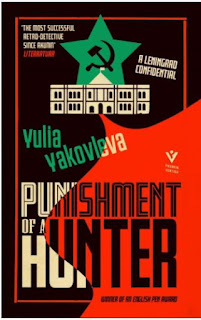
Yulia Yakovleva is one of the most entertaining and deft contemporary writers working in Russian today: she hops with agility between YA literature (we loved her The Raven's Children, which was longlisted for the 2020 Read Russia Prize) and adult detective thrillers like Punishment of a Hunter (Pushkin Vertigo, 2021) - although both titles we've so far have been set in the early Soviet period. There's plenty of political idealism, casual animosity, frustration, and filth to enjoy - I particularly appreciated the details in Punishment of a Hunter about the sheer difficulty of getting laundry done in a communal apartment. But while there's a wealth of Communist social context to enjoy, you may well find the plot too engrossing to notice - as Yakovleva's hero, Leningrad police detective Vasily Zaitsev, tries to solve a series of grisly crimes committed in his city. 

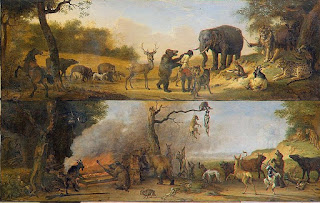
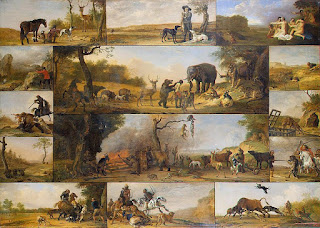
Meanwhile, I was trying to solve the mystery of why this excellent crime novel is called Punishment of a Hunter instead of The Leningrad Murders or Comrade Death or some such similarly suggestive, run-of-the-crime-mill name. The Russian title - literally, Suddenly Out the Hunter Runs - didn't help me either. Only as I approached the end did everything make sense - odd title, cute illustrations adorning every new chapter, and the oddly recurring theme of Dutch Masters in the Hermitage Museum. I can't explain without spoilers, so I'll summarize by calling Yakovleva's novel an ek-phras-tastic thriller: an honest, much-wronged detective lead recalling the excellent Arkady Renko of Martin Cruz Smith's late-Soviet crime series, a macabre serial killer who could have dropped out of a Chris Carter novel, and a setting straight out of one of Bulgakov's communal-apartment comedies. There's even a basis in historical fact for the big reveal (if not for the serial killings).

This is a novel where names, especially traditional 'speaking names' that reveal information about their bearer's character - are important, and Yakovleva's translator Ruth Ahmedzai Kemp has done a splendid job with this. She kept the hero's name, Zaitsev (a relatively common Russian surname) although English readers lose the subtle association with the hare (zaets), a game animal which features in the titular Dutch canvas by Paulus Potter (and hence the theme of the hunter becoming the hunted, important for Yakovleva's plot, is harder to discern). Another, less savoury detective is called Kishkin in the original (which evokes Tripes or Offal for the Russian reader); Ahmedzai Kemp smoothly changed this to the similarly evocative 'Uglov'. It's a 'speaking name' that works well in English, and one could certainly argue that this novel has quite enough evisceration going on already. I particularly enjoyed Ahmedzai Kemp's lively touch with dialogue, which always sounded vivid and real. There's a wonderful exchange between Zaitsev and a 'cabbie' (izvozchik), who, like all taxi drivers since the dawn of time, draws him into a political discussion. Zaitsev tries to close this down by trotting out some formulaic Sovietese: 'I'm just setting out the political situation in the country'. In Ahmedzai Kemp's translation, the cabbie responds, 'Ooh, check you out. Where you from then?' The original has 'Ty otkuda gramotnyi-to takoi' (Or, 'Where was it you learned to speak like that'?). I normally like my translations literal, but I admired the chutzpah of that 'Check you out'. It brought the cabbie to life in my head - just as any well-written text should achieve for its characters.

Pushkin Press are doing a laudable job of commissioning translations of crime fiction (including vintage detectives) from several languages through their Vertigo series: if you like historical crime, intelligent Russian fiction and a Soviet setting, check it out. It's worth hunting down.


Thursday, 21 October 2021

White Magic - timely tales for Halloween

My readers know I hate to blow my own fog-horn. I prefer to hide behind my human avatar everywhere except in the pages of this blog and my safe places in a few famous libraries. But since it's Halloween once again, time of creepy pumpkins, bewigged vampires and prancing werewolves, I should share with you my own contribution to the annual Danse Macabre: a baker's dozen of scary stories, White Magic: Russian Emigré Tales of Mystery and Terror, most - if not all - translated into English for the first time.
 
You'll find two vampires (maybe three?), several ghosts, Edgar Allan Poe in Russia, supernatural visions, a serial killer, a haunted mirror, a murderess who wasn't and a failed suicide, and two absolutely hilarious tales by Zamiatin. Women writers are well represented with tales by Teffi, Irina Odoevskaya, and Georgy Peskov (the pseudonym of Yelena Deisha, one of whose stories also featured in my previous collection Red Spectres). White Magic is a sequel to Red Spectres, although the books have different publishers; the 'White' in the title acknowledges that all the authors in this second anthology were Russian émigré authors whose political sympathies, by and large, lay with the losing, monarchist side in the Russian Civil War. Much of what they write is infused with the trauma of exile and loss, or more gently imbued with nostalgia. Ivan Lukash, a historical novelist whose fiction deserves to be better known, really goes to town in "The Bells", his condemnation of Bolshevik St Petersburg; while in the other Lukash tale I included, "Hermann's Card" is a supernatural follow-up to Pushkin's seminal story "The Queen of Spades". Here's a taste of "The Bells", which helps explain why they had to fire Lukash from the Leningrad Tourist Board in 1925:

In the Port on Vasilyevsky Island a rusty horse-tram crawls along. The shabby horses with their bald patches and sharp tailbones might be pulling a funeral bier, a rusty catafalque-tram. On top the corpse-passengers sway, knocking their bony shoulders one against the other. The wind from the Neva sweeps around their heads.

The rattling tram has crawled by…

On the Nikolayev Bridge the wind has piled up crumbly snow. Hissing, the snow whirled around feet, blew in faces. Petrov clutched his hat, as the fringes of his coat flapped: “Let the wind wail…”

Other authors include Alexander Amphiteatrov (who does a nice line in vampires), Pyotr Krasnov (a Cossack nationalist who wrote rampantly imperialist historical fiction and tragically threw in his lot with the Wehrmacht), Gaito Gazdanov, and Pavel Muratov (the only Russian author ever to die in County Waterford). The fact that I have now translated two different short stories called "The Venetian
Mirror" about spooky looking-glasses - one by Muratov in this collection, the other by Alexander Chayanov in Red Spectres - gives me great satisfaction. (Languagehat and I have had quite an interesting chat about Venetian mirrors and Russian literature). Languagehat kindly gave White Magic a rather nice write-up, and so did the stalwart Kaggsy, whose generous words you can read here if you're still wavering.

If you're in the US, you can buy White Magic direct from my excellent publisher, Russian Life, at this link. If you are anywhere else, you can order this book from Amazon (Amazon UK link here) or buy the Kindle version; and Red Spectres is still available too

Because my human avatar has been busy lately (obvious lie - she's on research leave, how can she be busy?), I've got a huge backlog of unwritten posts. More soon, I hope. Next up will be a post about Yulia Yakovleva's Punishment of the Hunter, a retro Soviet detective novel spunkily translated by Ruth Ahmedzai Kemp. I'm also enjoying Oliver Ready's new translation of the late great Vladimir Sharov's Be Like Children. But, until I write again, here's a few words of warning and a snippet from Amphiteatrov's story "The Cimmerian Disease", from the new collection. Warning first: if you're sitting up alone in your apartment on an icy, foggy night, reading your copy of Huysmans’ Là-Bas, and your valet interrupts to inform you that there's a "young person" asking for you at the street door, it's probably NOT a good idea to let her in. 

“What can I do for you?” I asked again, but, glancing at her delicate figure, I added unwillingly, “Please sit down, and wouldn’t you like a cup of tea? I’m sure you need warming up. I would even recommend you take a drop of wine or cognac with it.”

She looked dreadfully chilled; her face was greenish, her lips blue, her dress soiled with mud and wet to the knees. It was obvious she had come a long way on foot.

She sat down silently. I passed her a cup of a tea. She drank it in a single gulp, as if not noticing what she was drinking. The tea and cognac warmed her; her lips grew scarlet, her amber cheeks acquired a faint bloom. She really was very pretty. I wanted to see her eyes, but her eyelashes only trembled without rising. Her gaze fell full on me just twice, sharp and glittering, but each time surreptitiously, from the side, when I was turning away. As she nibbled some bread, she did, however, reveal excellent teeth – small, even, and white.

After my guest’s strange revelations to me regarding Petrov, I genuinely did begin to see her as a “mamselle” – one whose lover had cooled off and sent her packing. But I didn’t blame Petrov for the introduction, although I continued to wonder why he had dispatched this silent female in my direction.

So instead of asking her a third time what she wanted, I became rather jolly; I decided that, as fate had sent me a romantic adventure, I should make the most of it. I am not one of your sentimental suitors; when I like a woman, I try to be witty. However, my guest never once smiled; it was as if she didn’t hear my jests and compliments. Her face was fixed in an expression of dull tranquility. She sat with her hands on her knees, turned half away from me.

“I used to live here,” she suddenly interrupted me, turning neither her eyes nor her head my way, as if I were not even in the room. This stubborn inattentiveness both confused and annoyed me. I thought: She’s either a psychopath, or a hopeless idiot.

“It’s all different,” she went on, gazing into a corner of the room, “different – the wallpaper, and the floors…”  Aha, I thought, a vein of sentimentality – let’s make use of it.

“So you are very fond of this apartment, I see?” I asked, hoping to provoke some candid outpouring from her. Without replying, she rose and walked towards the corner she had been studying.

“This is where the stains were,” she said.

“What stains?” I was confused.

“Blood.”

Happy Halloween!


Monday, 19 July 2021

New kids on the bloc: the rise of Novichok fiction

It's intriguing to note the rise of the Novichok novel, especially given that the first high-profile Novichok poisoning case - the attempted murder of ex-agent Sergei Skripal and his daughter Yulia in the quiet English cathedral town of Salisbury in March 2018, by two clandestine Russian operatives - skirted so close to fiction. There was the tragically inept administration of the poison, which ultimately affected two innocent bystanders - of whom one died - and a serving police officer. There followed the tragicomic denials on prime-time Russian TV made by the two operatives, who expressed their earnest admiration for Salisbury Cathedral and its 123-metre spire. The Facebook page 'Advice for Russian Tourists' has made satirical hay with multiple memes featuring Russian "tourists" Aleksandr Petrov and Ruslan Boshirov (alias Anatolii Chepiga), reconfiguring them within a gently incompetent vision of spycraft: more Fawlty Towers than Philby. These guys don't need plausible deniability; never mind their flimsy cover story, the reality was so implausible it's easier to deny than accept.


That mixture of belligerence and bathos was once more in play in August 2020 when the would-be leader of Russia's political opposition, Aleksei Navalny, was near-fatally poisoned by Novichok powder sprinkled in the fabric of his underpants. On the one hand, this incident brought the concept of going commando to a whole new level; on the other, it emphasized the incalculable ubiquity of death-dealing in the post-Soviet era. Who needs a poisoned umbrella or an ice-axe when you can anoint a door-knob with poison or slip death under the waistband of somebody's Y-fronts?

Life may indeed be stranger than fiction, but fiction is not letting life have all the fun. Three contemporary novels - two recent, one still to drop - by well-known authors have fictionalized a scenario that already beggars most people's belief. The first I read was Slough House (2021), the seventh Jackson Lamb spy thriller by Mick Herron, one of only two authors to receive my ultimate saurian compliment: I pre-order their books at full price. Mick Herron writes anti-spy novels: his plots expose a contemporary British secret service undermined by desk-jockey careerism, underfunding, and toadying to Whitehall (one of the joys of reading this series is the evolving caricature of Boris Johnson). His heroes are a bunch of failed spies ("slow horses"), punished for various professional failures with permanent exile to London's dilapidated Slough House, where they file meaningless records under the fabulously alcoholic, balefully obscene and yet unflinchingly loyal guardianship of Lamb, a sidelined big beast of Cold War spycraft. It's almost a misnomer to call the series after Jackson Lamb, often the books' least-active, least-glimpsed character; we have free indirect access to the stream of consciousness of virtually everyone else, including Roddy Ho, whose nerdiness and woeful ineptitude somehow never silence the Bond movie looping in his head:

[...] Men were just better at the practical stuff - facts and stats, dude. Facts and stats. Time to take charge. Holding one commanding hand up to halt Shirley, Roddy put the other on the knob of the closed door. Twisted and pushed in one swift movement.
"Locked."
"Yeah, try pulling?"
He pulled, and the door opened on an empty toilet.
"Ho," she said, "you're as stylish as a man bun." (from Slough House)

In Herron's latest novel, a British revenge operation mounted on Russian turf in response to a Salisbury-style incursion has led to general stakes-raising, and to a deadly mission by some rather competent Russian agents. At the end of the novel, my favourite character's life hangs by a thread because he's just made a single, typically Slow Horse mistake; he opens a door. This door isn't dangerous because of what's on the far side (although Herron makes some nicely ironic play with the metaphor of opening a door onto a new stage of life). It's deadly because of what someone has put on the doorknob. Could parts of this narrative actually be true? Of course not; Herron's afterword reminds us that even if we notice "echoes" of "events in Wiltshire between March and July 2018", we should remember that "this novel is pure fiction". Of course it is.

Sergei Lebedev, a geologist by training now much better known for his serious and engrossing historical fiction, may have written the definitive Novichok novel in 2020 (translated by Antonina W. Bouis as Untraceable in 2021). In the original Russian, its title is Debiutant, Lebedev's transparent nickname for the poison, which Bouis translates as 'Neophyte'. Both capture the novelty echoed in the word Novichok (from novyi, Russian for 'new'). I won't review Untraceable at length here, since Robyn Jensen has penned this excellent piece in the LA Review of Books. Suffice it to say that Lebedev's real subject, as the Russian title emphasizes, is this elegant, untraceable poison pioneered in an ethically repellent ultra-secret Soviet closed city (inside a lab that makes the Siberian sharashka of Lionel Davidson's Kolymsky Heights look like Montessori playgroup). We learn about its origins (at the expense of the scientist's unborn child); its deadly successes; its long wait inside a meticulously insulated test tube (it accompanies the scientist into Western exile). We follow the GRU operatives sent to assassinate the scientist after his whereabouts are exposed. These agents, armed with another variant of Neophyte, are plagued by a succession of petty disasters that cumulatively unstring their mission. Like the real-life Salisbury hit squad, their cover is tourism. And we follow Neophyte at its terrible work. Untraceable was published just before Navalny's poisoning, but well after the Salisbury poisonings made headlines. The story opens with a sting (in more ways than one) against a retired spy who switched allegiances long ago. He realizes just too late that what he had taken for a "wasp sting" was in fact a skilful subcutaneous injection, delivered in a hilltop restaurant: 

With a final effort, he rose and holding on to the walls made his way into the corridor. His constricted throat kept him from screaming, calling for help. On the porch, he bumped into a waiter carrying a tray of bottles and wineglasses. The waiter assumed he was drunk and moved aside. He fell from the porch, taking the waiter with him, hearing the crashing glass and hoping that everyone noticed and was looking. He hissed and gurgled into someone's ear: "Ambulance... police.. murder... not drunk... poison... I was poisoned."
And he collapsed, still hearing the sounds of the world but no longer understanding what they meant. (from Untraceable)

The last of my trio is a novel not yet released, by redoubtable spy novelist Charles Cumming. Its immediate prequel (introducing recurring characters), Box 88 (2020), is the polar opposite of Herron's Slough House. Slough House is under the conventional radar because it's a dump for failed spies; whereas Box 88 is the Jack Reacher, the monster shake, the Perfect Manhattan of secret agent organizations. It's the best of MI6 and the CIA, kept secret from even those organizations and feeding back to senior government officials on a strictly need-to-know basis (and mostly deciding they don't need to know). Box 88 agents can do Black Ops without fear of media repercussions; they can track your Deliveroo orders by finding out your mobile number; they can put an electronic bubble around your house to stop you communicating with the outside world. Judas 62, the second book in the Box 88 series, opens in a Soviet closed city where biochemical weapons are developed, then leaps forward to 2020, mid-Covid-lockdown, to sketch the demise of an elderly Russian-general-cum-Box-88-mole who now lives under an assumed name in Connecticut. Two Russian agents, including an FSB officer disguised as a US mailman, break into the old man's cabin in the Adirondacks. Without leaving any other trace of their presence, they lace the former general's glaucoma medication with a poison which we recognize as a variant of Novichok. Sure enough, when the familiar symptoms take hold, the unfortunate old man only just has time to call his CIA handler before collapsing. Now we learn that JUDAS is "a list of Russian intelligence officers, military personnel and scientists living in the West who had been targeted for reprisal assassinations by Moscow. Alexander Litvinenko had been JUDAS 47, Sergei Skripal [...] JUDAS 14". Hang on - is this novel tracking fact, or fiction? We can't be sure, because who knows what else might have happened by the time Judas 62 appears in print in October 2021. As up-to-the-minute as Cumming's novel is, life may well have stolen a lead on fiction yet again by the end of this year.

Just wait until we start to see the Havana Syndrome subgenre hitting our bookshelves...


Wednesday, 4 March 2020

Kissing Tolstoy, or Dammit, Dostoyevsky!


Regular readers will appreciate that although my posts are often pretty highbrow, I'm most interested in how what's currently perceived as "high culture" gets recycled by so-called "low culture". Hence I've blogged about Poldark and the Brothers Karamazovwhy James Norton doesn't speak Russian; and even about how the BBC uses Great Russian Novels to finger TV villains. There is, however, endless fun in exploring how one of the lowest genres of all - so low you need a bathysphere for access, or at least a bath with lots of scented bubbles and pink prosecco - interacts with classic literature. I have in mind, of course, the Adult Romance. Readers, I give you Penny Reid's Kissing Tolstoy

Fear not, this is no 19th century kiss-and-tell. Tolstoy's presence in the story is purely vicarious (and to judge by the front cover illustration, he's probably Pushkin, anyway). Russian literature, especially War and Peace, inspires clever but self-doubting sophomore Anna to sign up for a senior class in the topic. After running out on a blind date with a man she found disturbingly attractive, Anna resigns herself to being single: as she warns the sisterhood, "Men who ride motorcycles, who wear leather like a second skin, and look hot doing it, they don't date ladies who idolize Tolstoy". After preparing herself for class by reading every book on the reading list (basically all of Russian literature) except for Chernyshevsky's What Is To Be Done and Gorky's Mother (and we sympathize), Anna rejoices: "I was obviously with my people. I was with the lovers of Dostoevsky and Chekhov" (I do hope not). Only moments later, however, she's ruing her decision to take Russian lit: "Dammit, Dostoyevsky! Why did you have to be so tragic and compelling?" 

Not at all predictably, her new professor, smouldering second-generation Russian-Ukrainian emigre Luca Kroft, just happens to be the guy from the bar. As their eyes meet over a stack of Onegin handouts, Anna reflects: "Not only did he look good in leather pants, fabulous in a suit with a bow-tie, was a world expert on Russian literature, but also he apparently spoke Russian. Flawlessly. Flee! He is temptation incarnate. He will steal your soul with sexiness." And while the ending may fail to surprise ("Ms Harris, can you explain what attracted you to the ripped, sensitive, yet masterful Tolstoy-quoting bachelor who is so well-endowed his family funds most of the University's tenured positions?"), we can still value Ms Reid's novel for the innovative use she makes of the classics. First of all, Anna and Luca verbalize their feelings for each other by comparing themselves to Tolstoy's characters: he sees her as Natasha, and thus tells her to wait for her Pierre. When Anna realizes that Luca has cast himself as Andrei, she needs to come up with a new version of War and Peace in which Natasha and Andrei stay together. Secondly, however, Anna draws eclectically on 19th-century prose to put her emotions in context. Here is her response to a tense feedback session with Luca: "If only I had an autopsy to perform - like Bazarov, in Fathers and Sons - it certainly would have been an excellent excuse to flee." Best of all, however, is the moral lesson that Anna (and Ms Reid) share with us in conclusion: "If Russian literature and tragic novels had taught me one thing, it was this: disappointment and heartache might be around the next corner. But adventure, love, joy, and happiness - the living of a rich, meaningful life - was now."

We applaud the message of Kissing Tolstoy (although we fear Tolstoy would not). Another genre author who knows her Lev Nikolaevich is Jilly Cooper. Here she is summarizing Anna Karenina for The Guardian: '... [T]here's lots of sex. And Tolstoy obviously knew all the upper classes backwards, because he was a member of them and moved in those circles. He captures the double standards very well. That's the more terrible aspect of the story – Anna's brother shags the nanny and immediately he's forgiven by the wife and nobody minds at all, and Vronsky goes back into society and everybody goes, "Whoops, oh well, never mind!"'

Thankfully, the Russian classics continue to inspire popular genre-writing: I'm intrigued by Death with Dostoevsky, an American campus thriller by Katherine Bolger Hyde (whose other titles include Arsenic with Austen, Bloodstains with Bronte, Cyanide with Christie and - more surprisingly - Everything Tells Us About God). I expect great things from it. Let's not forget, as Claire Whitehead points out in her excellent recent book The Poetics of Early Russian Crime Fiction 1860-1917 that Dostoevsky himself never fully extricated his characters from the mire of genre fiction; or that, as scholar Cathy McAteer contends in her forthcoming monograph, Dostoevsky's translator David Magarshack's crime thriller Big Ben Strikes Eleven (1934) adapts several formative elements from Crime and Punishment. Clearly, crime pays, and so does Russian literature. As Dorothy Parker never wrote:
Men frequently make passes
At girls who take Tolstoy classes.

Further note to regular readers: Google stopped notifying me about new comments, and for a long time I sadly resigned myself to believing that no-one was reading this blog any more. It was a pleasant surprise when I finally fixed the glitch and discovered that I had many moons of unread comments awaiting approval! If you feel inspired or just critical, please do take a moment to sound off about one of my posts.
I should add that I have just discovered the website Netgalley and I promptly signed up to review two new anthologies of Gogol translations - by Susanne Fusso and Oliver Ready respectively. I will write about both in a new post soon!


Monday, 27 January 2020

The Fact That... (Or, Dinosaurs, Newburyport)


The fact that it isn't possible to read anything these days without finding a reference to a major Russian writer, the fact that I was reading Ducks, Newburyport the other day and I really thought I was safe for once with all those cinnamon rolls and Obamacare but then the narrator segued into talking about Solzhenitsyn, the fact that she was remembering her beloved mother and then bam! Solzhenitsyn just pops up out of nowhere like this:

[...] Mommy smoking, the fact that she used to lie on a towel on the beach and read a book while we swam, book, sunglasses, and I thought she was so beautiful, Jane Austen, the fact that one summer she was reading Cancer Ward, a huge book, and there was a big picture of him on the back, Solzhenitsyn, and he had a sort of Amish beard, the fact that I don't know if he picked that up in Vermont or it's a Russian thing, "It's a Russia thing", the fact that you never see Solzhenitsyn smiling [...]

The fact that (and I'll stop this now) either Lucy Ellmann or her narrator need to get out more, as it's easy to see Solzhenitsyn smiling; he's practically an Internet meme. Here he is, cracking up:


The ubiquity of Russian literature references aside, I am ever-intrigued by those writers who weave a Russian classic into their plot. This kind of intertextuality is de rigueur in Russian prose fiction; overseas, it's more of a surprise - not least because it shows how other cultures have made these texts their own, re-inventing them for new. There is all too little critical literature on how Russian writing, in translation, has shaped non-Western cultures either directly (in terms of imitation) or indirectly (in terms of political or aesthetic attitudes). In Steven Marks’ enlightening chapter section
about Dostoevsky’s worldwide influence, he suggests that the great Russian nineteenth-century writers were so popular in societies such as Japan and the Middle East, where they penetrated in the early 1900s in translation, because 'Russian literature taught the art of social and psychological inquiry, and in particular dealt with the familiar problem of making the transition from a traditional to a new way of life' (p. 97). Hence we get international echoes, for example, J.M. Coetzee using Dostoevsky's own persona and characters in The Master of Petersburg (1994); and even more exotically, Atiq Rahimi's not extremely good recasting of Crime and Punishment in modern Afghanistan, A Curse on Dostoevsky (first published in French as Maudit soit Dostoïevksi, 2011).  Every so often, however, Russian originals get used in an even more subtle way: not as plot templates, but as plot drivers - demonstrating how meaningfully plots and archetypes can persist away from their home culture.

My example for today is from Négar Djavadi’s Disoriental (2016; translated from the French by Tina Kover, 2018). As the narrator of the story is a female bisexual atheist Iranian refugee, it's fairly likely that Dostoevsky would not have personally approved of her. Nevertheless, Crime and Punishment defines a key moment of anagnorisis in the lives of the narrator's father and grandmother. (Disoriental tracks back and forth between a Paris fertility clinic, where the narrator is struggling to start her own family, with flashbacks to her parents and other relatives in mid-twentieth-century Iran). Here, her father, Darius, the most intelligent and politically aware person in the family (not least by his readings of Russian authors) has stolen a gun and is on the verge of shooting his despised father, Mirza Ali. 


Mother burst into the courtyard and inserted herself between the gun and Mirza Ali. [...] "Don't do this," she begged. "Please, son. Don't do this. If you pull that trigger, you'll be a criminal. You'll end up in prison, and..."
As the words tumbled around in my grandmother's head, seemingly having no effect on her son, she became aware of an unexpected flash of clarity in the back of her mind. All of a sudden, she knew with absolute certainty the origin of the anguish that was eating away at him, She had felt the same thing when she read the book she'd found among Darius's things, its pages battered and filled with scribbled notes,. It was Darius she'd seen in that tortured character. Darius who was, who might become...
"What do you want? To end up like Raskolnikov?" she shouted.
The shock of hearing his mother say that name was so great that Darius’ arm fell to his side. Suddenly, reality took on a new dimension. He saw her now. No longer the powerless, docile mother, but the woman who had read Dostoevsky, had patiently deciphered each sentence, had educated herself in silence. This woman, he did not doubt, had the strength to stand up for herself against her husband. She didn't need her son to defend her any more (p. 65-6).

So Darius doesn't shoot, and his mother leaves her husband for a new life in the city. And thus, long before Lolita, Dostoevsky was empowering women in Tehran... Enough irony there to make Solzhenitsyn smile.


Attributions:

  • Steven G. Marks, How Russia Shaped The Modern World: From Art to Anti-Semitism, Ballet to Bolshevism (Princeton, NY and Oxford: Princeton University Press, 2004)
  • Dover Beach blog, for happy Solzhenitsyn pictures.